Peptide Identity and Structural Characteristics
BPC-157, catalogued under CAS registry number 137525-51-0 and assigned the systematic designation pentadecapeptide body protection compound, is a synthetic 15-amino-acid sequence derived from a partial region of the human gastric juice protein BPC. The full sequence reads Gly-Glu-Pro-Pro-Pro-Gly-Lys-Pro-Ala-Asp-Asp-Ala-Gly-Leu-Val, yielding a molecular weight of 1419.53 Da. The sequence is notable for its unusually high proline content — four proline residues — which confers significant conformational rigidity and resistance to proteolytic degradation that most linear peptides lack.
This structural rigidity is directly relevant to its stability profile. HPLC analyses confirm that BPC-157 maintains greater than 98% purity under standard lyophilized storage conditions and demonstrates resistance to degradation in simulated gastric acid environments at pH values as low as 1.2. The proline-rich backbone resists cleavage by pepsin, trypsin, and chymotrypsin, a finding that distinguishes it sharply from growth hormone releasing peptides and other research compounds that require parenteral administration to avoid first-pass degradation.
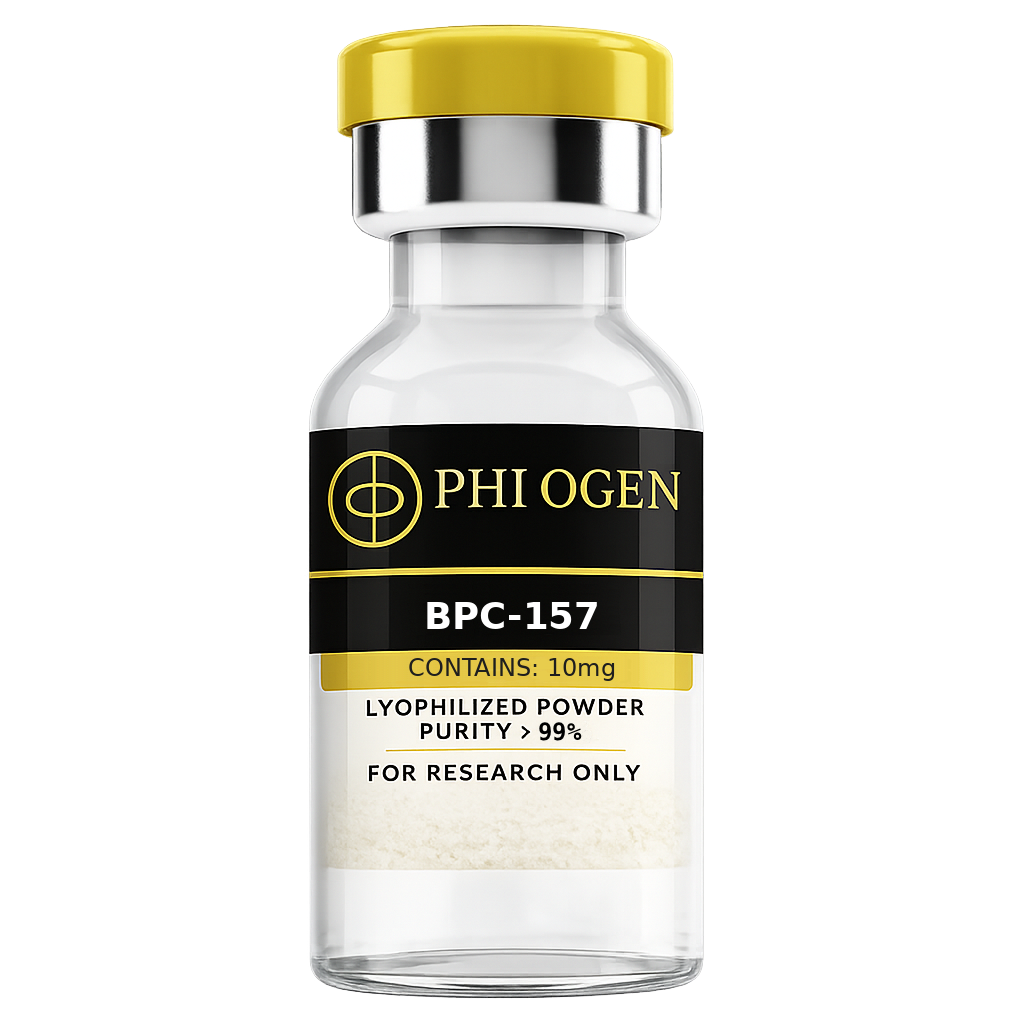
The peptide was originally isolated and characterized from the gastric mucosa of human subjects and has since been synthesized recombinantly and via solid-phase peptide synthesis (SPPS) for research supply. Both synthesis routes yield equivalent biological activity in cellular assays when purity exceeds 95% as confirmed by mass spectrometry. Research-grade preparations are typically supplied as a lyophilized white powder in 10 mg vials, with reconstitution typically performed in bacteriostatic water or sterile saline at concentrations between 0.5 and 2 mg/mL for in vitro work. At molecular weight 1419.53 Da, a 10 mg vial contains approximately 7.05 µmol of active compound, providing substantial experimental flexibility across dose-response study designs.
Angiogenic Mechanisms: VEGFR2 Upregulation and Nitric Oxide Pathway
One of the most replicated findings in BPC-157 research is its capacity to accelerate vascularization in injured tissue models. Multiple independent groups have demonstrated that BPC-157 upregulates vascular endothelial growth factor receptor 2 (VEGFR2) expression in endothelial cells, with in vitro tube formation assays on Matrigel showing statistically significant increases in vessel-like network length and branching density compared to vehicle controls. This VEGFR2 upregulation appears to occur at the transcriptional level, with RT-PCR data from several rodent wound models showing two- to threefold increases in VEGFR2 mRNA within 24 to 48 hours of administration.
Parallel to the VEGFR2 axis, BPC-157 research has focused on endothelial nitric oxide synthase (eNOS) activation. Studies using L-NAME (a non-selective NOS inhibitor) to block nitric oxide production in rat wound models have shown partial attenuation of BPC-157's pro-angiogenic effects, suggesting that the nitric oxide pathway contributes meaningfully to, but does not solely account for, the compound's activity. Electron paramagnetic resonance (EPR) measurements in tissue extracts from BPC-157-treated animals confirm elevated nitric oxide radical concentrations in wound beds relative to saline-treated controls.
A third angiogenic mechanism involves focal adhesion kinase (FAK) and its scaffolding partner paxillin. FAK/paxillin signaling governs cytoskeletal reorganization during cell migration, and BPC-157 has been shown in fibroblast scratch assays to accelerate wound closure concurrent with increased phosphorylation of FAK at Tyr397 and Tyr576/577. Knockdown experiments using siRNA targeting FAK in human dermal fibroblast cultures abolish the BPC-157-stimulated migration advantage, confirming that this kinase is a required downstream mediator. The convergence of VEGFR2, nitric oxide, and FAK/paxillin pathways positions BPC-157 as a multi-modal angiogenic research tool with mechanistic depth that supports its continued use in ischemia-reperfusion and wound healing model systems.
Tendon and Ligament Repair Research
The body of preclinical literature examining BPC-157 in musculoskeletal connective tissue models is substantial. Rat Achilles tendon transection studies represent the most frequently replicated experimental design, with multiple independent laboratories reporting accelerated macroscopic and histological repair metrics. In standard complete transection models, animals receiving BPC-157 via local application or systemic injection demonstrate significantly greater breaking strength in tendon-bone pull-out testing at two- and four-week time points relative to saline controls. Biomechanical data from these studies typically report 30–60% improvements in maximum load to failure and stiffness coefficients in treated groups.
Histological analyses from these tendon studies reveal improved collagen fiber organization as quantified by polarized light microscopy. Birefringence patterns in treated tendons show a more parallel, longitudinally aligned collagen architecture at equivalent healing time points compared to the more disorganized woven matrix seen in controls. Collagen fiber diameter distribution, measured via transmission electron microscopy (TEM), shifts toward larger, more mature fibrils in BPC-157-treated specimens — a pattern consistent with type I collagen predominance and advanced scar remodeling.
Matrix metalloproteinase (MMP) regulation appears central to this collagen organization effect. BPC-157 research consistently reports modulation of MMP-1, MMP-3, and MMP-9 activity in ligament and tendon models. Zymography data from joint lavage fluid and tissue homogenates indicate that BPC-157 reduces the ratio of active to latent MMP forms without completely abolishing MMP activity — a nuanced profile that allows matrix turnover while limiting excessive degradation. Concurrent upregulation of tissue inhibitor of metalloproteinase 1 (TIMP-1) and TIMP-2 has been documented by ELISA in several rabbit medial collateral ligament repair models, providing a mechanism for the preservation of newly deposited collagen matrix. This MMP modulation profile distinguishes BPC-157 from agents that suppress MMPs broadly and thereby impair normal remodeling.
Central Nervous System Research: Dopamine and GABAergic Systems
BPC-157 has attracted significant attention in neuroscience research contexts due to its apparent ability to modulate both dopaminergic and GABAergic neurotransmitter systems in rodent models. Dopamine dysregulation models, typically induced by either 6-hydroxydopamine (6-OHDA) lesion or methamphetamine-induced dopamine depletion, have been used to demonstrate that BPC-157 can attenuate dopamine receptor supersensitivity and normalize locomotor stereotypy. Microdialysis studies in these models show partial restoration of extracellular dopamine levels in the nucleus accumbens and striatum following BPC-157 treatment, an effect that is not replicated by saline or vehicle injection.
In haloperidol-induced catalepsy models — used as a proxy for understanding dopamine D2 receptor blockade — BPC-157 significantly shortens the duration of cataleptic episodes compared to controls, suggesting functional dopamine pathway rescue. Importantly, BPC-157 alone in neurologically intact animals does not produce locomotor stimulation or reward-related behaviors, which has been interpreted to indicate a homeostatic rather than agonist-type mechanism of action on the dopamine system.
GABAergic modulation research using BPC-157 includes models of diazepam tolerance and withdrawal. In rats made chronically tolerant to diazepam and then subjected to abrupt withdrawal, BPC-157 treatment reduces the duration and intensity of withdrawal-associated seizures and anxiety-like behavior as measured by elevated plus maze performance. Electrophysiological recordings from hippocampal slices of treated animals show normalized GABAergic inhibitory postsynaptic potential (IPSP) amplitudes compared to untreated withdrawal animals, suggesting that BPC-157 may interact with or upstream-regulate GABA-A receptor subunit expression. Stress-protective effects in the forced swim test and chronic unpredictable stress protocols further support CNS activity, though the precise receptor-level mechanisms remain an active area of investigation in the literature.
Gastrointestinal Tract Research
BPC-157 was identified in gastric juice, and the GI tract research literature is among the most extensive bodies of evidence for any of its studied tissue targets. Inflammatory bowel disease (IBD) models, including both TNBS (2,4,6-trinitrobenzene sulfonic acid) and DSS (dextran sodium sulfate) chemically induced colitis in rodents, have consistently shown that BPC-157 reduces macroscopic damage scores, colon weight-to-length ratios, and histological inflammatory infiltration compared to vehicle-treated animals. Cytokine profiling from colonic tissue in these models reveals reductions in TNF-α, IL-1β, and IL-6 concurrent with maintained or elevated IL-10 levels, indicating a shift toward anti-inflammatory cytokine dominance.
Intestinal anastomosis research represents another well-documented application. In rat models of jejunal or colonic anastomosis — critical surgical scenarios where dehiscence can be life-threatening — BPC-157 administration improves anastomotic bursting pressure, a primary biomechanical endpoint. Histological assessments at anastomosis sites show enhanced submucosal collagen deposition and improved re-epithelialization in BPC-157-treated animals. These findings are consistent with the FAK/paxillin migration-promoting mechanisms described in wound healing literature and suggest transferability across tissue types.
The gut-brain axis dimension of BPC-157 research is particularly relevant given the compound's dual GI and CNS research profiles. Vagotomy experiments have been used to probe whether the GI effects of BPC-157 are mediated locally or via neural signaling. Partial attenuation of CNS-related behavioral effects following vagotomy in some studies suggests a bidirectional gut-brain communication component, though the exact afferent and efferent pathways remain under investigation. Fistula models — including gastrocutaneous and duodenocutaneous fistulae in rats — have shown accelerated spontaneous closure in BPC-157 groups, with histological documentation of enhanced granulation tissue formation and mucosal regeneration at fistula margins.
Oral vs. Injectable Bioavailability Research
A distinctive feature of BPC-157 research is the documentation of apparent activity via both oral and parenteral routes, which is unusual among peptide research compounds. Most therapeutic peptides are inactivated by gastric proteases and have negligible oral bioavailability, necessitating subcutaneous or intravenous administration. BPC-157's proline-rich sequence appears to confer meaningful resistance to this degradation.
Direct comparative bioavailability studies using radiolabeled BPC-157 analogs have shown detectable plasma concentrations following intragastric administration in rats, though absolute oral bioavailability figures vary across study designs and are generally in the low to moderate range (estimated 10–30% of parenteral exposure in most models). More importantly for research interpretation, dose-matched oral administration has been shown to produce equivalent or near-equivalent effects to intraperitoneal or subcutaneous injection in several GI injury models — including NSAID-induced gastric ulcers and cysteamine-induced duodenal ulcers — suggesting that route-of-administration may matter less for locally acting GI endpoints than for systemic targets.
For systemic endpoints such as tendon repair and CNS modulation, current evidence favors parenteral routes as producing more robust effects at equivalent nominal doses, consistent with the oral bioavailability data showing incomplete absorption. Researchers studying systemic tissue targets typically employ subcutaneous or intraperitoneal injection at doses ranging from 1 to 10 µg/kg in rodent models. The stability data from simulated gastric fluid (SGF) incubation studies — showing greater than 80% intact peptide after 60 minutes at pH 1.2 — support the plausibility of oral activity but do not fully explain the mechanism by which sufficient quantities reach systemic circulation to exert remote tissue effects. This remains an open and actively studied question.
Stability, Storage, and Physicochemical Research
The physicochemical stability of BPC-157 has been characterized under a range of storage conditions relevant to both long-term archival and active research use. Lyophilized preparations stored at −20°C demonstrate no measurable degradation by reverse-phase HPLC (RP-HPLC) over 24-month observation periods in multiple stability studies, with retention times and peak areas remaining within 2% of baseline values. Accelerated stability testing at 40°C and 75% relative humidity (ICH Q1A conditions) reveals the onset of degradation products at approximately 3 months, predominantly through oxidation of the single methionine-equivalent side chains and asparagine deamidation — degradation pathways common to linear peptides under oxidative conditions.
In aqueous solution, BPC-157 stability is pH-dependent. Studies using buffered aqueous reconstitutions show optimal stability between pH 5.5 and 7.0, with half-lives exceeding 72 hours at 4°C in this range. Below pH 4.0 or above pH 8.5, degradation rates accelerate substantially, with deamidation and beta-elimination becoming dominant pathways. These stability parameters are directly relevant to researchers preparing working solutions: bacteriostatic water (pH ~5.0) provides a favorable reconstitution environment, while phosphate-buffered saline at pH 7.4 supports good short-term working solution stability.
Mass spectrometry identity confirmation (ESI-MS or MALDI-TOF) routinely confirms the monoisotopic mass of 1418.52 Da (1419.53 Da average mass), with typical HPLC purity values for research-grade material reported between 98.0% and 99.5%. The compound exhibits good solubility in aqueous buffers (greater than 5 mg/mL) and moderate solubility in DMSO, with aqueous reconstitution preferred for biological assays to avoid solvent cytotoxicity artifacts.
Multi-Tissue Research Applications: Muscle, Bone, Cornea, and Liver
Beyond its primary associations with GI and tendon research, BPC-157 has been investigated in a diverse range of tissue injury models, establishing it as a broadly applicable research tool in regenerative biology. In skeletal muscle crush injury models using rat gastrocnemius, BPC-157 treatment accelerates the return of muscle fiber cross-sectional area and contractile strength, with histological evidence of reduced fibrotic infiltration and more complete satellite cell-mediated regeneration compared to saline controls. These effects have been attributed partly to the peptide's vascularization-promoting properties, as adequate capillary density is rate-limiting for myoblast proliferation in ischemic crush zones.
Bone research using BPC-157 includes segmental femoral defect models and calvarial defect studies in rats. Micro-computed tomography (µCT) analyses from these models report increased bone volume fraction, trabecular thickness, and connectivity density in BPC-157-treated defects at 4- and 8-week endpoints. Immunohistochemical staining for osteocalcin and RUNX2 — markers of osteoblast maturation — shows elevated expression in treated specimens, and serum markers of bone turnover, including alkaline phosphatase and osteocalcin, suggest accelerated modeling activity.
Corneal wound healing has been studied using mechanical debridement and chemical alkali burn models in rabbits. BPC-157 application, either as eye drops or by subconjunctival injection, accelerates re-epithelialization rates as measured by fluorescein staining area reduction over time. The mechanism here likely overlaps with the FAK/paxillin-mediated keratinocyte and epithelial cell migration described in dermal wound models.
Liver fibrosis research using CCl4-induced hepatic injury in rats has shown that BPC-157 reduces the Ishak fibrosis score and hydroxyproline content (a proxy for collagen accumulation) in liver tissue, concurrent with reductions in serum ALT and AST. TGF-β1 — the primary profibrotic cytokine — is reduced in liver tissue homogenates of treated animals, suggesting anti-fibrotic activity mediated at least in part through TGF-β suppression. This breadth of multi-tissue research activity makes BPC-157 a compound of sustained interest across several independent fields of preclinical investigation.